Forget the ABCs: Why MARCH-E is the Only Survival Protocol You Need
Discover why the traditional ABC first aid method fails in wilderness trauma, and how the MARCH-E protocol stops severe bleeding to save lives off-grid.
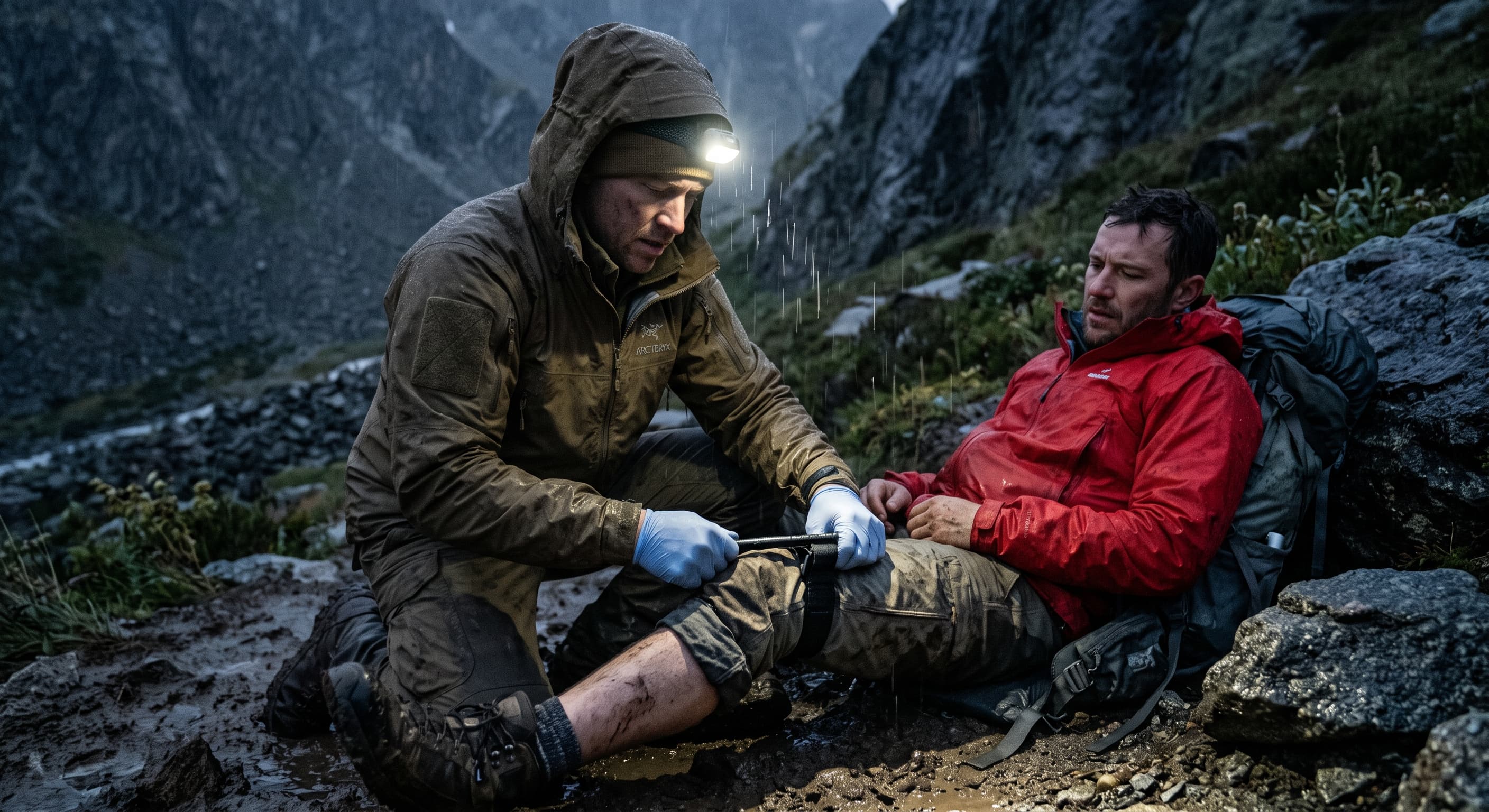
You are five miles from the nearest trailhead. Your climbing partner slips on a wet scree slope, tumbling 20 feet into a jagged ravine. When you reach them, a piece of fractured granite has sliced their thigh. Bright red, pulsating blood is rapidly pooling into the dirt. Panic sets in. If you took a standard frontcountry first aid class, your brain might automatically default to the golden rule: A-B-C. Airway, Breathing, Circulation.
So, you drop to their head, tilt their chin back, and check if they are breathing.
Congratulations. By the time you confirm their airway is clear, they have bled to death.
The Problem: Why the Urban "ABC" Protocol Fails in the Wild
In a city, the "Golden Hour" rules supreme. An ambulance is 8 minutes away, and the ABC protocol assumes a rapid transfer to a sterile surgical bay. But in the wilderness, the Golden Hour evaporates. You are operating under the unforgiving laws of Prolonged Field Care (PFC).
"Blood belongs in the body. You cannot oxygenate a patient who has no red blood cells left to carry the oxygen. Stop massive bleeding first—seconds count." – Dr. Mouine Khalil Errahmane Ameur, Off-Grid Medical Care
Pathophysiologically, total airway obstruction causes irreversible brain death in 4 to 6 minutes. But a severed femoral artery? That will cause fatal exsanguination in under 3 minutes. The wilderness provider must address physiological derangements in the exact order that they cause cellular death. That is why tactical and off-grid medics abandon the ABCs in favor of a superior cognitive offloading tool: MARCH-E.
The Solution: The MARCH-E Algorithm Deep Dive
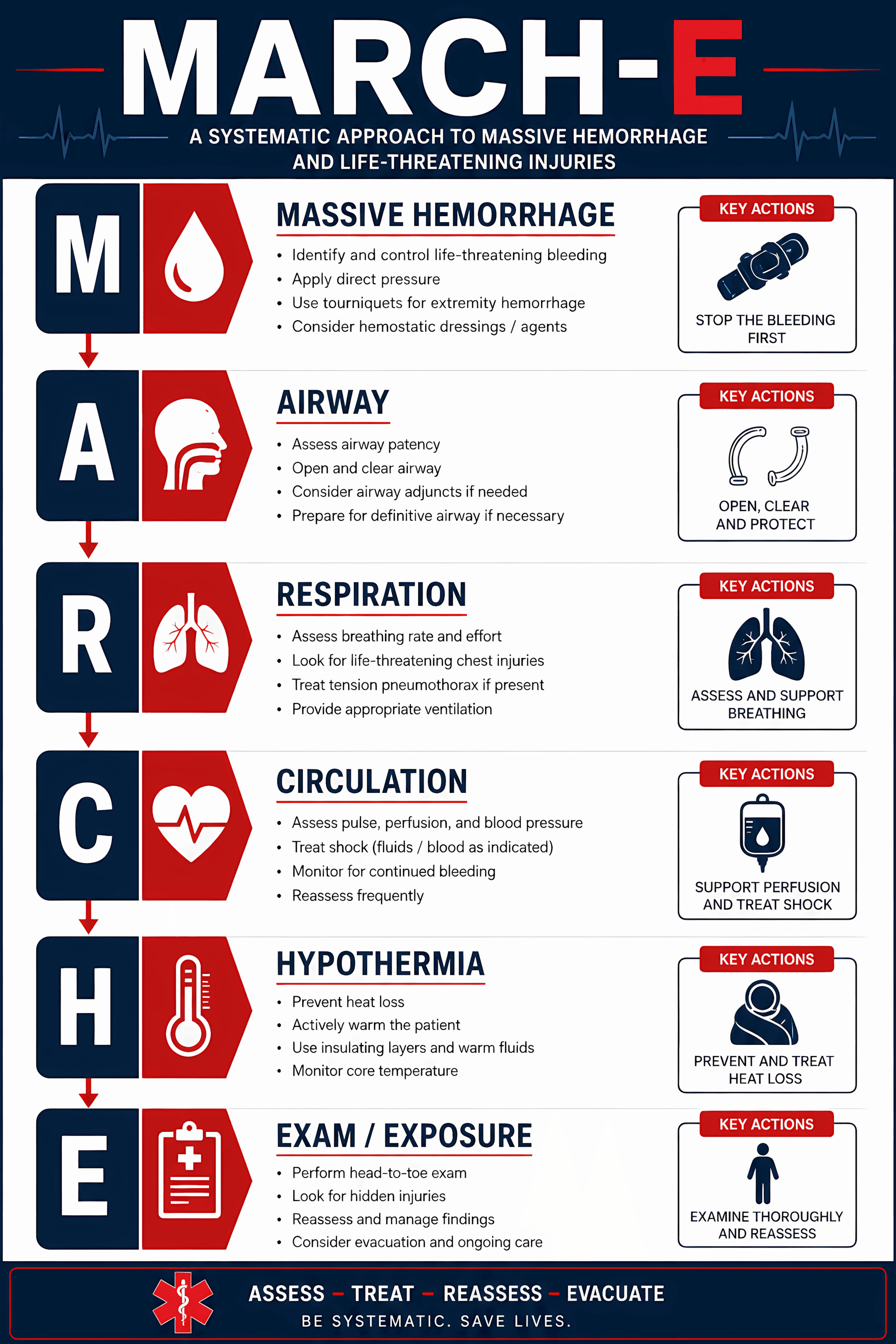
MARCH-E is an investigative framework designed to halt the "Lethal Triad of Trauma"—hypothermia, coagulopathy (failure to clot), and metabolic acidosis. Here is how you execute it:
- M – Massive Hemorrhage: Do not look; feel. Perform an aggressive tactile "Blood Sweep" using gloved hands from the neck down to the boots. If you find arterial bleeding, apply a windlass tourniquet "high and tight." For junctional wounds, pack the cavity deeply with hemostatic gauze and hold maximal pressure for 3 minutes.
- A – Airway: Once the bleeding is stopped, check the airway. If a spinal injury is suspected, use a Jaw-Thrust maneuver. If they are vomiting, immediately log-roll them into the recovery position.
- R – Respirations: Expose the chest. Look for uneven movement. Seal any open, sucking chest wounds with a vented chest seal.
- C – Circulation: Assess perfusion without machines using the 80-70-60 rule. Check the pelvis; if it's unstable, apply a pelvic binder to stop hidden internal bleeding.
- H – Head & Hypothermia: Assess their neurological status using AVPU. Immediately insulate them from the ground. Hypothermia paralyzes clotting enzymes, restarting the bleeding you just stopped.
- E – Expose & Evacuate: Cut away bulky, blood-soaked clothing to find hidden injuries, but immediately wrap them in a windproof, waterproof "burrito" wrap. Make your critical triage decision: Load and Go, or Stay and Play?
Practical Steps: Applying MARCH-E Today
- Audit Your Kit: Move your tourniquets and trauma shears to the outside of your pack. You have 3 minutes; you cannot be digging for gear.
- Train the Sweep: Practice performing a tactile blood sweep on a partner in under 30 seconds.
- Pace Your Panic: When disaster strikes, check your own pulse first. Take a deep breath to defeat tunnel vision before touching the patient.
Master the Art of Wilderness Survival Medicine
MARCH-E is just the beginning. How do you convert a tourniquet after 4 hours? How do you improvise a pelvic binder using a fleece jacket and a carabiner? Stop guessing when lives are on the line. Get the complete, evidence-based protocols, 100+ diagrams, and field-expedient MacGyver techniques in the definitive 410-page manual: Off-Grid Medical Care.